
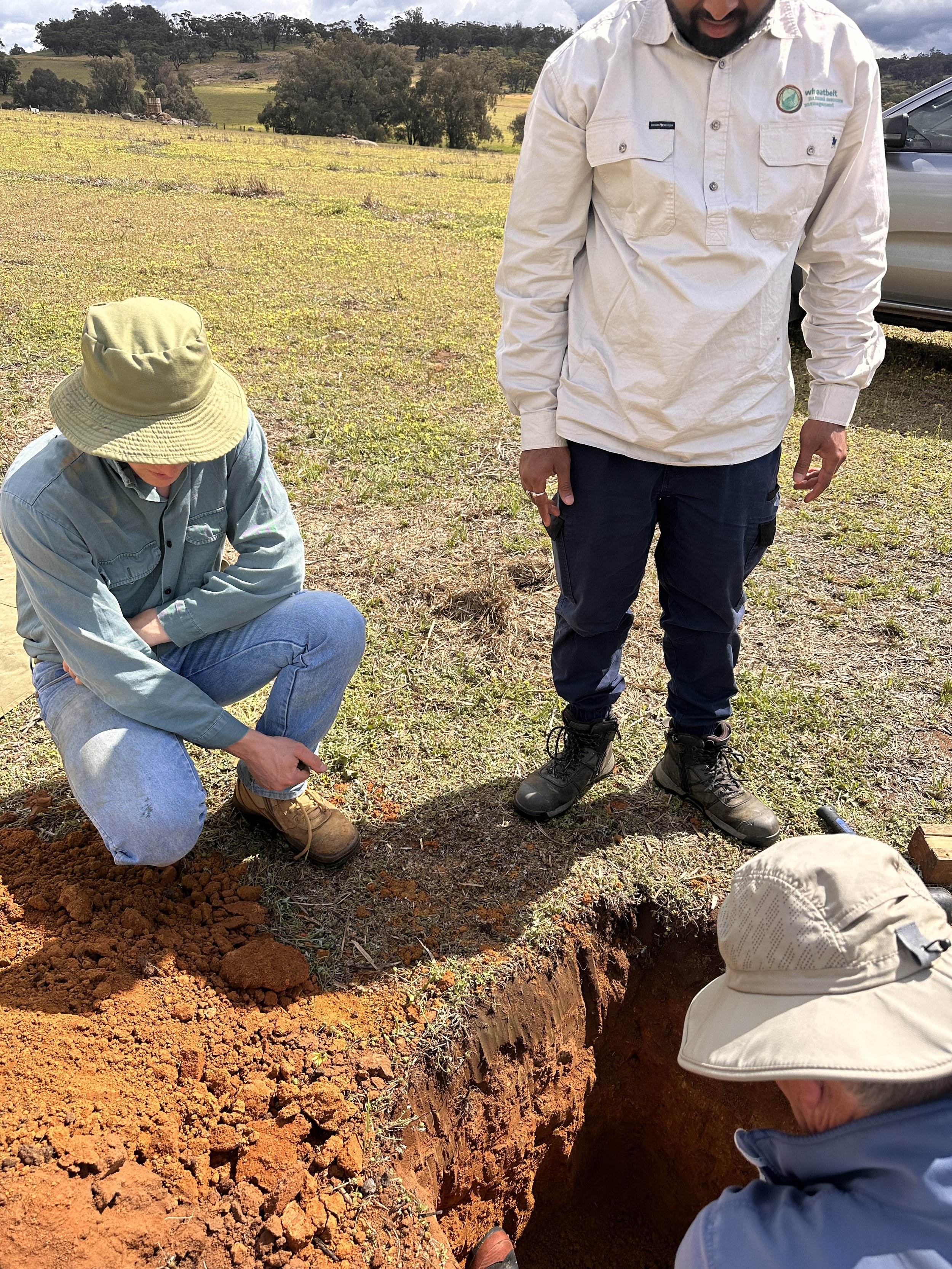
For many Wheatbelt farmers, rising fertilisers costs and soil constraints are increasing the focus on how organic materials can be used more effectively to improve soil health and nutrient efficiency.
Two Soil CRC research projects are tackling this challenge from different angles, but with a shared goal: to make better use of organic amendments to improve soil function. The projects provide a deeper understanding into the way biosolids and other organic materials can be applied in farming systems.
Dr Aravind Suapaneni’s project Application of liquid biosolids, investigates whether nutrient-rich organic waste materials such as biosolids (sewage sludge), could provide a more cost-effective option for farmers facing increasing fertiliser prices. Using waste materials in this way also responds to the need for disposal options that are both environmentally responsible and economically practical.
On a lot of Australian farms, soil constraints both at the surface and deeper in the profile limit the ability of crops to access water and essential nutrients. This project explores whether biosolids can help lift soil nutrient levels and improve overall soil function.
Australia’s cities generate large volumes of wastewater and solids, creating a significant environmental footprint. Finding safe and cost-effective ways to manage sewage sludge is an ongoing challenge. The project’s aim is to assess the agronomic benefits and environmental risks of injecting liquid biosolids into the subsoil in Victoria, Australia.
Meanwhile, Dr Girish Choppala’s Soil CRC project on Unlocking soil nutrients with organic amendments is examining what happens once organic materials are in the soil.
Many Australian soils already contain large nutrient reserves, particularly phosphorus. The problem is that much of this phosphorus is tightly bound to soil minerals and unavailable to plants. As a result, additional fertiliser is often applied even when nutrients are already present in the soil.
Declining natural resources, such as phosphate rock and water availability mean that enhancing nutrient use efficiency in agricultural soils is essential for sustainable production.
The research team tested two liquid organic products to see if they could help make phosphorus more available to crops:
Earthworm casting liquid (EL) - a liquid made from earthworm activity
Pyroligneous acid (PA) - a wood-based liquid produced during charcoal or biochar making
Researchers tested three common Australian soils from Condobolin NSW. Small amounts of EL and PA (0.1% and 1%) were added to the soils and monitored to see how phosphorus changed.
The key findings were:
Both EL and PA increased plant-available phosphorus, especially loose and organic forms.
Earthworm liquid worked best at the 1% rate.
In clay soils, EL reduced iron-bound phosphorus, which normally ties up phosphorus and makes it unavailable to plants.
EL lowered problem iron compounds by around 14-22%
Results suggest EL binds to iron in the soil
PA reduced calcium-bound phosphorus at higher rates, likely by slightly lowering soil pH.
Looking ahead
Both these projects provide valuable insights, pointing toward a more integrated approach to soil management, where organic amendments are applied more precisely and therefore unlock nutrients already present in the system.
For farmers, approaches like these allow for ways to improve soil performance without continually increasing inputs. It also allows for a future for more effective waste management, that works to support the environment and benefit growers.
Soil CRC’s research to more deeply understand how organic amendments interact with soil chemistry helps build a stronger framework that demonstrates how organic materials can support more resilient and productive farming systems.
If you would like to learn more about projects like these, please visit the Soil CRC website.
References
Soil CRC. (n.d.). Application of liquid biosolids. https://soilcrc.com.au/projects/application-of-liquid-biosolids/
Soil CRC. (2021, June 3). Project update: Application of liquid biosolids. https://soilcrc.com.au/project-update-application-of-liquid-biosolids/
Supported by the Cooperative Research Centre for High Performance Soils (Soil CRC).
Published eNews #413, April 2026