
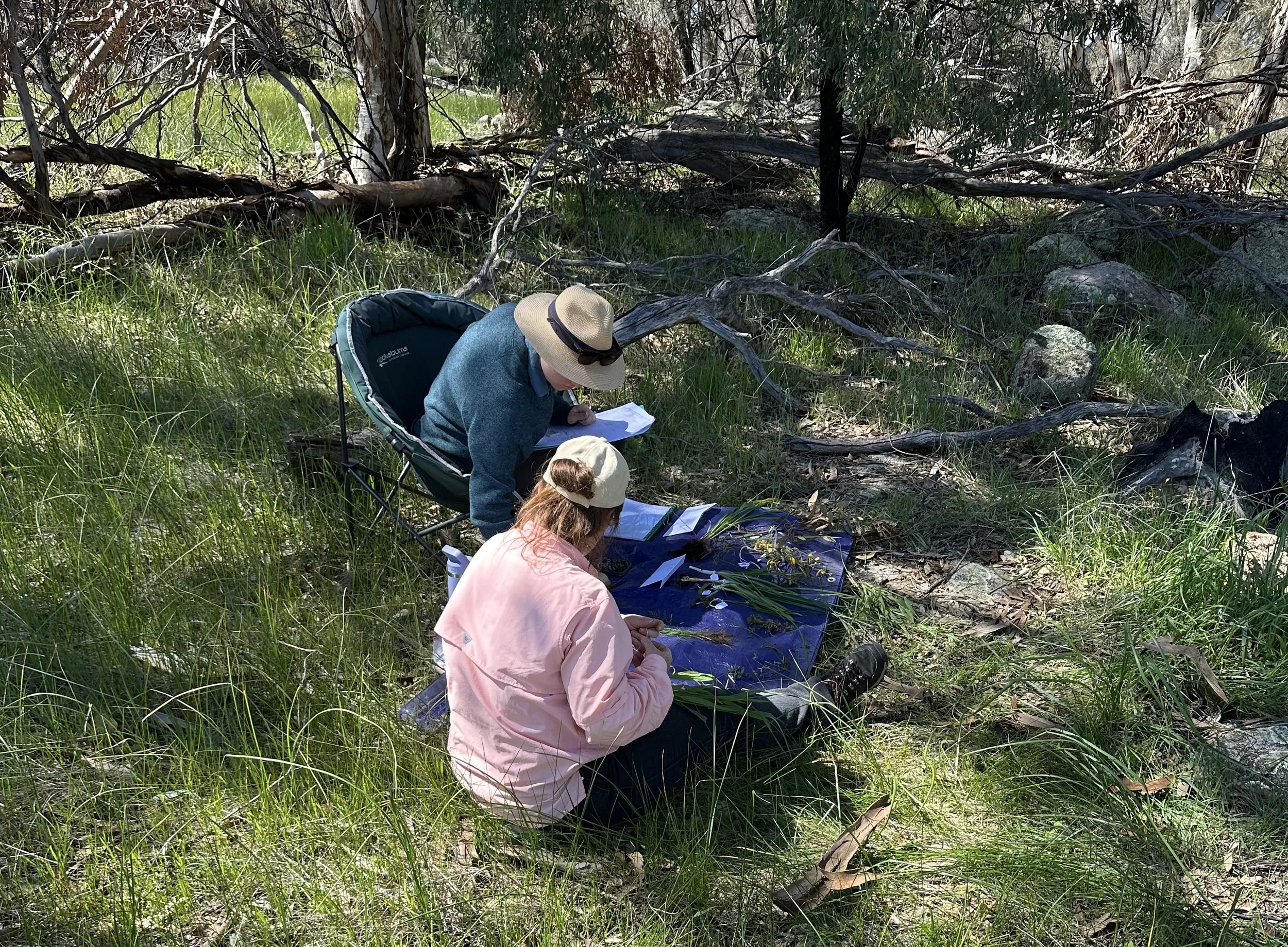
Healthy Environment team members conducting flora surveys.
Over the past two months, the Healthy Environments team has been busy out in the field, carrying out 20 baseline habitat condition surveys across 8 properties owned by landholders partnered in new conservation projects with Wheatbelt NRM.
In combination with similar surveys conducted this time last year, we have now assessed 38 sites across 19 different properties in the Wheatbelt region. These surveys are the essential first step in understanding the current condition of native vegetation before any on-ground activities begin in our two key conservation projects.
The first project focuses on conserving the Eucalypt Woodlands of the WA Wheatbelt, a nationally Threatened Ecological Community that provides vital habitat for vulnerable native species like the Chuditch (Western Quoll). The second project targets the iconic endangered Carnaby’s Black-Cockatoo, working to improve and protect critical breeding and foraging areas, to improve and protect critical breeding and foraging areas.
Surveying across a series of standardised quadrats, the team has been recording the plant species present, their percentage cover and abundance, along with tree size measurements. This information provides an ecological benchmark of habitat condition for each site. The data collected will be crucial when the team returns in 2027, two years after the implementation of targeted conservation measures, to repeat and compare results. This will allow us to evaluate changes in habitats and biodiversity to measure the impact of our own, and our partner landholders’, vital conservation work.
Many of our landholders have noticed changes on their properties and the Wheatbelt over their lifetimes, but often lack the resources or time to enact any real form of improvement. By partnering with Wheatbelt NRM by being part of our projects, landholders can not only manage their properties sustainably but also contribute to long term health and stewardship of the Wheatbelt’s unique ecosystems upon which both people and wildlife rely.
Wheatbelt NRM is offering significant financial and logistical support for landowners to undertake on-ground activities such as:
Revegetation
Stock-exclusion fencing
Feral animal control
Weed management
Installation of artificial dens or nest hollows for threatened native species like Chuditch and Carnaby’s Black Cockatoos
Interested in getting involved?
If you’re a landholder in the Avon River Basin with a large area of remnant vegetation, please contact our Project Manager, Kate Sherlock at KSherlock@wheatbeltnrm.org.au to learn how you can access funding and support to enhance biodiversity on your land.
_____________
This project is funded by the Australian Government Natural Heritage Trust and delivered by Wheatbelt Natural Resource Management, a member of the Regional Delivery Partners panel.
Published eNews #408 – November 2025