
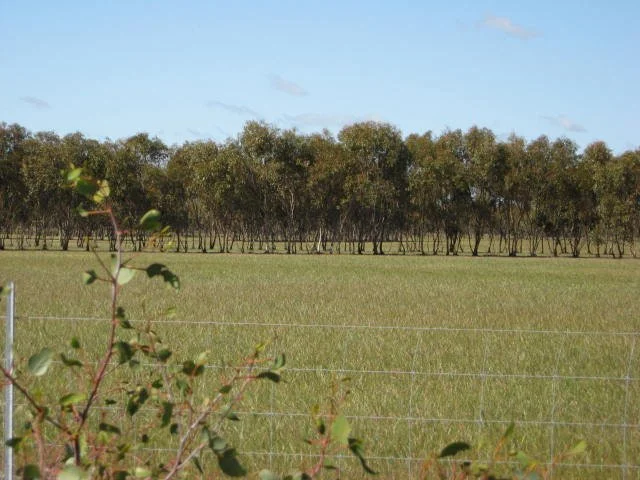
Wickepin Oil Mallee Field Walk 2012
Across the Western Australian Wheatbelt, rows of oil mallees remain as a legacy of one of the region’s most ambitious responses to dryland salinity.
Many were planted during the 1990s and early 2000s, when governments, researchers and farmers were searching for perennial species that could protect agricultural land, create a new source of farm income, and to use more water as it was thought that taking up more water would lower the water table and remove secondary salinity. There were a few issues with this - first is that lateral movement of water doesn’t really occur, or occurs geologically slowly, so trees planted in one spot don’t affect the water table. Secondly, salt can remain on/near the surface once the water lowers.
Although the commercial industry did not develop at the scale originally proposed, the trees did not disappear. Thousands of kilometres of mallee belts are still growing across Wheatbelt farms. Recently, a renewed commercial interest in renewable fuels, biomass, biochar and environmental markets is prompting a fresh look at their value.
Oil mallees are hardy, multi-stemmed eucalypts adapted to the low-rainfall conditions found across much of inland Western Australia. Unlike many single-stemmed trees, mallees grow from an underground woody structure known as a lignotuber, producing coppice regrowth and allowing them to regenerate after their stems are harvested.
The modern WA oil mallee program began in the early 1990s, largely in response to the threat posed by rising groundwater and dryland salinity. The idea was to integrate belts of deep-rooted perennial vegetation into cropping and grazing systems without taking whole paddocks out of production while combating salinity and losses in biodiversity.
By the early 2000s, about 1,000 farmers had established mallee belts across more than 12,000 hectares of the Wheatbelt. The plantings were intended to provide several benefits at once:
manage groundwater recharge and dryland salinity;
reduce wind erosion;
provide shelter for livestock and crops;
create habitat and connections between areas of remnant vegetation;
protect saline or erosion-prone areas; and
produce a harvestable woody crop.
The original commercial vision was based on processing the whole tree. Leaves could supply eucalyptus oil, while the woody material could be used for electricity, charcoal and activated carbon. Harvesting trials and processing technologies were developed, but high transport and processing costs, an immature market and the difficulty of establishing processing facilities at sufficient scale meant that a lasting industry did not emerge.
So, why is interest returning?
The economic landscape surrounding biomass is now changing.
Industries such as aviation, mining, heavy transport and agriculture are looking for lower-emissions alternatives to fossil fuels. At the same time, governments are placing greater emphasis on domestic fuel security and regional manufacturing.
In 2025, the Western Australian Government committed $1.2 million to develop an Advanced Biofuels Strategy. The work includes an assessment of the State’s available biomass, supply chains and conversion technologies. Importantly for the Wheatbelt, the government has identified mallees alongside cereal stubble, canola and plantation residues as potential ‘biomass’ feedstocks.
The woody biomass from mallees can be converted into products including:
renewable diesel and sustainable aviation fuel;
woodchips, pellets, heat or electricity;
biochar;
eucalyptus oil;
wood vinegar and other biorefinery products; and
charcoal or activated carbon.
Several processing pathways can produce more than one product from the same feedstock. This is important because earlier research found that mallee systems were more likely to become commercially viable when the whole tree was used and income came from several products, not eucalyptus oil alone.
For landholders with established mallees, the clearest future commercial opportunity is likely to be the sale of harvested biomass to a processor, of which there are several small operations in the Wheatbelt and one large-scale, commercial processor in Kalannie. The renewable diesel and sustainable aviation fuel (SAF) refinery being developed in Esperance by Renewable.bio has explicitly listed oil mallee material to be within its primary feedstock.
Mallees are well suited to this model because they can be cut close to ground level and regrow from their lignotubers. In principle, this allows repeated harvests without replanting the trees each time.
There are a lot of considerations when investigating if a new planting will be beneficial to the farm business. However, the value of a planting will depend on much more than the amount of wood standing in the paddock. Important considerations include:
distance from a processing facility or collection point;
total area and volume available;
belt width, row layout and machinery access;
tree species, age and condition;
expected regrowth after harvest;
harvesting, chipping and transport costs;
moisture content and feedstock specifications; and
whether a buyer offers a long-term supply or offtake agreement.
Biomass is bulky and relatively expensive to transport. Consequently, local processors accessing coordinated supply from several farms may be necessary before harvesting becomes economic. With increasing interest across Australia, the market may be heading for more opportunities in the near-term as Western Australia’s processing and refinery capabilities increase.
Growers should therefore be cautious about assigning a dollar value to their trees before there is a confirmed buyer, specification and delivery price. A price offered at the processing facility is not the same as the amount that remains after harvesting and freight costs.
What should landholders do now?
Landholders do not necessarily need to harvest, remove or radically change their mallees today. The most useful first step is to understand what they have.
Consider recording:
the location, length, width and approximate area of each planting;
planting year and species, if known;
current height, density and condition;
access for harvesting and transport equipment;
distance to major roads and potential processing centres;
evidence of previous harvesting and regrowth;
nearby remnant vegetation or habitat connections; and
any benefits the belts provide to livestock, soils or paddock management.
Neighbouring growers may also benefit from working together. A processor is more likely to consider a district that can demonstrate a reliable, aggregated supply of biomass than a collection of small and unrecorded plantings.
Before harvesting, landholders should confirm relevant clearing, environmental and local-government requirements. They should also obtain independent advice before signing contracts that affect ownership of the biomass, carbon rights, biodiversity rights or future land management.
Oil mallees were originally promoted as a way of combining salinity management with a new regional industry. While that industry did not develop as quickly as hoped, the basic idea a harvestable perennial crop integrated into Wheatbelt farming systems remains relevant.
While studies have shown little to no impact on salinity, existing plantings already provide benefits such as shelter, erosion control, landscape connectivity, carbon storage and biodiversity refuges. Their next opportunity may come from being part of a larger feedstock network supplying renewable fuel, biochar or other bioproducts.
For now, the opportunity is emerging rather than guaranteed. But as WA assesses its biomass resources and develops an advanced biofuels industry, growers who know the location, volume and condition of their mallees will be better placed to respond when buyers begin looking for feedstock.
Published eNews #419, October 2026