
There’s No Place Like Home: But an Artificial Nest Will Work in a Pinch!
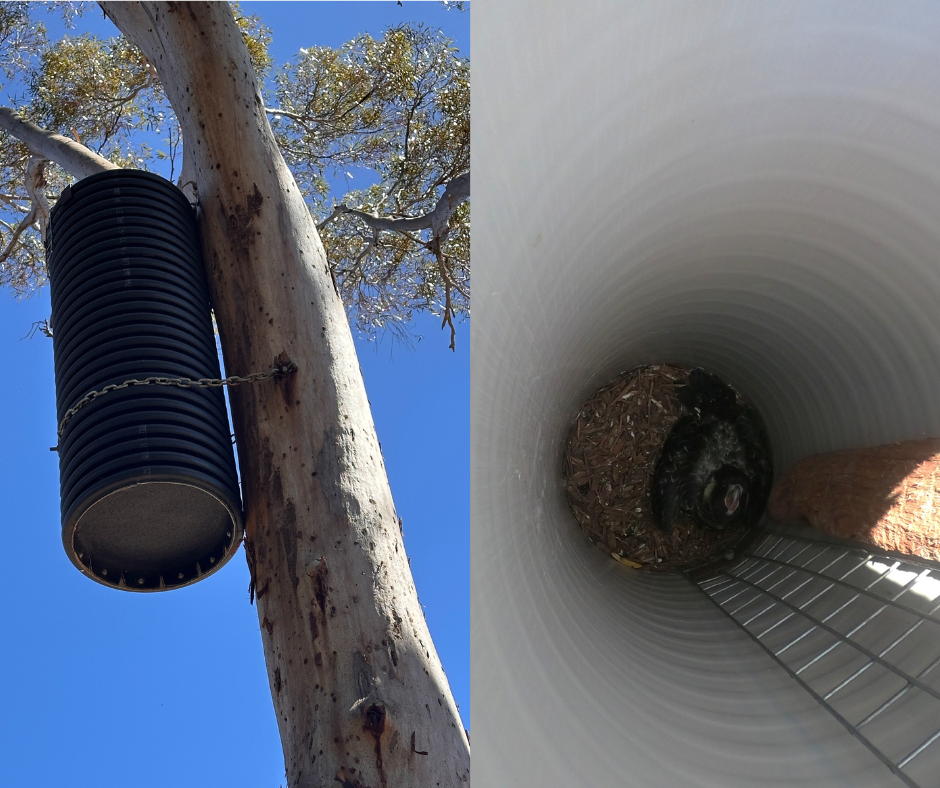
Carnaby’s black cockatoo artificial nesting boxes
The Carnaby’s black cockatoo was listed as an Endangered species in 2009, due to its long-term population decline which nearly halved since 1960. The primary causes for the decrease in population are extensive clearing of native vegetation, loss of large tree hollows needed for breeding and increasing competition for remaining nesting sites by other species. Ongoing habitat fragmentation across the Wheatbelt and south-west WA continues to limit breeding success, making active intervention essential to prevent further decline.
Our project team has been working with private landowners, local authorities, and Birdlife Australia through the Commonwealth Government’s Regional Landcare Delivery Partnership to increase the number of breeding sites for the Carnaby’s using artificial nesting boxes.
In November and December of 2025, we surveyed more than 70 prospective Carnaby’s breeding hollows, including those in mature eucalypts containing nesting hollows (e.g. Salmon Gum and Powderbark Wandoo), and locations where artificial black cockatoo nesting tubes had been installed.
Excitingly, we observed that this beloved species is continuing to make use of artificial nesting tubes, thereby adapting their breeding behaviour to make the most of new breeding sites, in the face of a dwindling supply of natural hollows.
Competing nesting grounds
In our 2024 surveys, we observed Carnaby’s in natural hollows, but this year we did not find Carnaby’s in those natural hollows.
However, we did find evidence that other bird species might also be using these hollows, potentially out-competing black cockatoos for these limited natural breeding habitats.
Similarly, we also observed significant numbers of feral bee colonies in natural tree hollows, thereby decreasing the number of natural nest sites available for use by Carnaby’s.
Natural hollows of sufficient size for cockatoos often take more than a century to form in mature eucalypts, therefore our work to protect existing old-growth woodland, revegetation with suitable tree species, and augmentation of trees with artificial nesting structures are crucial for the long-term survival of this much-loved and iconic species in the Wheatbelt.
Report a Sighting
Report a sighting of Carnaby’s at the link here. These sightings help our project teams find the best spots for new nesting boxes.
Would you like a flock of Carnaby’s to call your backyard home?
Do you have bushland on your property that is used by Carnaby’s for feeding, nesting or roosting? Wheatbelt NRM is offering significant financial and logistical support to landowners to undertake on-ground activities that benefit these charismatic birds, such as:
Revegetation
Stock-exclusion fencing
Feral animal control
Weed management
Installation of artificial nesting tubes for Carnaby’s Black Cockatoos
Download an application form here and our team will be in touch with you soon!
Want more information on NRM for your patch?
Many of our landholders have noticed changes on their properties over time, including shifts in climate and rainfall, increasing pressure from feral species, and changes in native plants and wildlife. While these challenges can be difficult to tackle alone, partnering with our friendly staff gives landholders access to practical support, funding, and expertise to improve land conditions, strengthen resilience, and protect the long-term health of the Wheatbelt’s landscapes for both people and wildlife.
Please contact our Project Manager, Kate Sherlock to learn how you can access funding and support to enhance biodiversity on your land.
This project is funded by the Australian Government Natural Heritage Trust and delivered by Wheatbelt Natural Resource Management, a member of the Regional Delivery Partners panel.
Published eNews #410, January 2026