
The Australian Hoverfly: A Quiet Workhorse for Wheatbelt Farms and Bushland
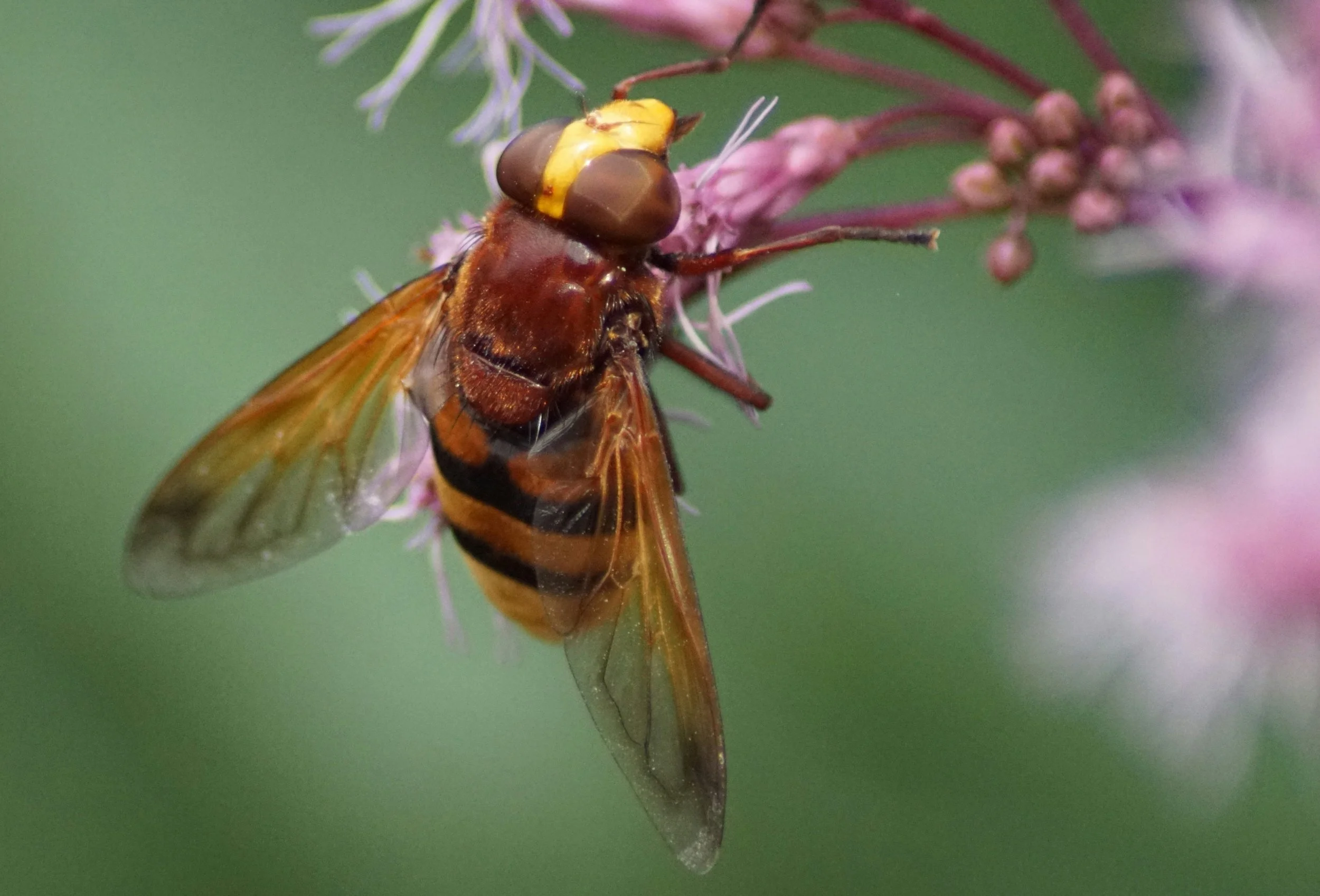
Hover flies (family Syrphidae) are among Australia’s most useful “beneficial insects”. Adults are often seen hovering deftly around flowers, while many species’ larvae are active predators of aphids and other soft-bodied pests—making hover flies valuable for both pollination and biological control.
What are hover flies?
Despite their wasp-like stripes, hover flies do not sting. Their mimicry is a defensive strategy to deter predators. Adults feed primarily on nectar and pollen, which also makes them effective pollinators in a range of environments, from gardens and remnant bushland to agricultural landscapes.
The “hidden” life stage is often the most important for farmers: many hover fly larvae are specialised aphid hunters. Females commonly lay eggs near aphid colonies; the emerging larvae consume large numbers of aphids before pupating. Being both pollinator and pest-eater makes hover flies some of the most beneficial insects on the farm.
Hover flies in Western Australia and the Wheatbelt
South-west Western Australia supports a diverse hover fly fauna, and common, widespread species are regularly recorded across WA. One well-known example is Simosyrphus grandicornis (often called the yellow-shouldered stout hover fly), broadly distributed across the country.
For the WA Wheatbelt—where broadacre cereals, canola, legumes and pastures dominate—hover flies matter because they intersect two recurring management priorities:
Aphid suppression. Seasonal aphid activity in cereals is a persistent issue, and DPIRD advisory material explicitly notes hover flies among the natural enemies that can increase and help keep aphid populations below damaging levels (particularly when unnecessary spraying is avoided).
Resilient agroecosystems. Hover flies are part of the broader beneficial insect community that underpins integrated pest management: keeping pest pressure lower, reducing reliance on broad-spectrum insecticides, and supporting overall on-farm biodiversity.
How to support hover flies in Wheatbelt landscapes
Hover flies need food (nectar/pollen) and, for predatory species, prey habitat (plants that host aphids at non-damaging levels). Flowering resources—native daisies, everlastings and other flowering plants—can draw adults in large numbers, while aphid-infested plants provide egg-laying sites that kick off larval control. Practically, this points to maintaining flowering diversity along paddock edges, road verges, riparian lines and revegetation areas, and being strategic with insecticides so beneficial populations can build rather than collapse.
Finally, Australian research suggests some hover flies are capable of long-distance seasonal movements, meaning Wheatbelt populations may be replenished or redistributed across the landscape as conditions shift.
In a drying climate and increasingly variable seasons, that mobility—and the ecosystem services hover flies provide—makes them a small insect with outsized regional value.
What to look for in the paddock: Hover fly ID box
Adults
Size similar to a small bee or wasp
Yellow, orange or cream bands on a dark body
Large eyes and short antennae
Distinctive hovering flight, often stopping mid-air before moving on
Frequently seen on flowering crops (e.g. canola), weeds, and native plants
Not-A-Bee
Only one set of wings
Short antennae, Large eyes
No stinger
Eat aphids!
Not as fluffy
Larvae
Legless, soft-bodied, slug-like appearance
Green, brown or grey; often well camouflaged
Found within aphid colonies on leaves and stems
No obvious head or legs (unlike caterpillars)
Can you see them? Key clues
Aphids present but declining without spraying
Flowering diversity nearby
High insect activity without visible crop damage
References
Australian Government Department of Agriculture, Fisheries and Forestry (DAFF). (2021). Integrated pest management in Australian grain systems. Canberra, ACT.
Department of Primary Industries and Regional Development (DPIRD). (2023). Aphids in cereals: identification, thresholds and beneficial insects. Government of Western Australia.
https://www.agric.wa.gov.au
Department of Primary Industries and Regional Development (DPIRD). (2022). Beneficial insects in broadacre cropping systems. Government of Western Australia.
https://www.agric.wa.gov.au
Hopper, S. D., & Gioia, P. (2004). The Southwest Australian Floristic Region: Evolution and conservation of a global hot spot of biodiversity. Annual Review of Ecology, Evolution, and Systematics, 35, 623–650.
Invertebrates Australia. (2020). Hover flies (Family Syrphidae).
https://www.invertebratesaustralia.org
McQuillan, P. B., & Reid, C. A. M. (2019). Field guide to insects of Australia. CSIRO Publishing, Melbourne.
National Insect Identification Network (NIIN). (2024). Syrphidae (hover flies) species profiles.
https://www.ento.csiro.au/niin
NSW Department of Primary Industries. (2021). Hover flies: pollinators and aphid predators.
https://www.dpi.nsw.gov.au
Skevington, J. H., et al. (2019). Field guide to the flower flies of Australia (Diptera: Syrphidae). CSIRO Publishing, Melbourne.
Williams, C. M., & Dixon, A. F. G. (2007). Life cycles and feeding behaviour of aphidophagous hoverflies. Biological Control, 42(3), 258–268.
Published eNews #410, January 2026